
How to Run a Property Management Company: A Practical Guide
September 29, 2026
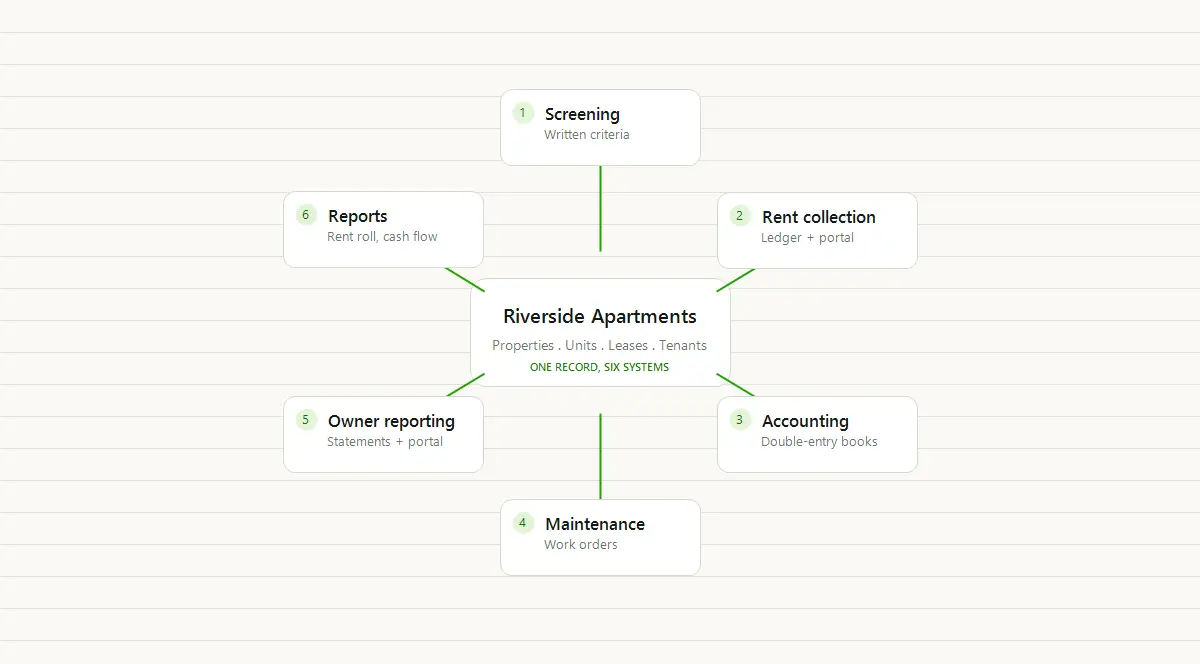
Every rental portfolio eventually stops being a side project and starts being a business, whether you manage three houses for yourself or two hundred units for a dozen owners. That shift shows up less in the number of doors and more in whether the systems behind them hold up: whether you can say what a tenant owes without adding it up, whether an owner’s statement is ready when they ask, and whether a slow month in maintenance costs you money instead of just time.
In 2025, the United States had 460,400 jobs for property, real estate, and community association managers, with a median pay of $69,990 a year, and the Bureau of Labor Statistics projects 4% employment growth through 2035, per the Occupational Outlook Handbook. This guide shows how to run a property management company, self-managed or fee-based: setting up the right structure, screening tenants, collecting rent, keeping real books, handling maintenance, reporting to owners, and choosing the software that holds it all together.
How to run a property management company: the six things it covers
Whether you are managing your own rentals or running a fee-based company for other owners, the job breaks into the same handful of operational domains:
- Leasing and tenant relations: screening, move-in, and keeping tenants who pay on time.
- Rent collection: getting paid reliably and knowing who owes what.
- Accounting: real books that produce a tax return and a statement without a scramble.
- Maintenance and vendors: keeping the property in shape without every job becoming a fire drill.
- Owner reporting: if you manage for other people, the statement that keeps their trust.
- Compliance: fair housing, deposit law, and, if you manage for others, licensing.
Everything below maps to one of those six, plus the records and reports that tie them together, in the order you’ll actually run into them.
How to start a property management company
If you are starting from scratch, most people follow the same path, and it begins with the systems rather than the clients:
- Run your own rentals, or a few properties, on real systems first. Written screening criteria, a tenant ledger, books by property, and a maintenance process. You learn what breaks while the stakes are low.
- Check your state’s licensing rules before you take on an owner. Managing property for someone else for a fee is regulated in most states (details below).
- Choose a business structure and get insured. An LLC or similar entity, general liability coverage, and, depending on your state and services, errors and omissions coverage. An accountant and an attorney are worth an hour each here.
- Write a management agreement. It is the contract that defines what you do, what you charge, and what the owner approves.
- Set up a separate account and an owner statement before the first owner client. Other people’s money should never touch your operating account, and the statement is what proves that.
- Take on one or two owners, then grow on referrals. Owners who get a clear statement every month talk to other owners.
Every step after the first depends on the systems in the rest of this guide being in place.
Set up your records before your first owner client
Before any of the day-to-day systems work, the records underneath them need a structure. A property contains one or more units. Each unit has a lease, with a start date, an end date, a rent amount, and a security deposit. A lease has one or more tenants. Riverside Apartments has a building full of units; Oak Street Duplex has two. Flatten that into a single spreadsheet row per property and the details that matter, like which tenant on a shared lease paid what, get lost. Keep it as four linked records and everything downstream, from the tenant ledger to the owner statement, follows from it.
The other piece of structure is the chart of accounts: the list of categories every dollar posts to. Set it up once, with properties tracked as a dimension rather than duplicated per-property accounts, and every report you run later comes out clean instead of requiring a rebuild.
Screen and onboard tenants consistently
The tenant relationship is the foundation everything else sits on, and it starts before the lease. Pre-qualify by phone or email, screen every applicant against the same written criteria (income, credit, rental history, background), and apply those criteria identically to everyone, in writing, so a screening decision never looks like it turned on a protected characteristic. The tenant screening checklist and tips for screening tenants both walk through the process step by step.
Consistency here isn’t just fair housing hygiene, though it is that. A tenant who was actually screened well is a tenant who pays on time, which is most of what makes every system after this one easier.
Collect rent on a system, not by memory
Rent collection is where a lot of informal management falls apart, because “check who paid” turns into checking a bank app against a mental list. A tenant ledger (the rent ledger explained) fixes that: a dated list, per tenant, of every charge, every payment, and every credit, with a balance that is calculated from those entries rather than typed in by hand.
Two things make that ledger run itself instead of demanding upkeep. Recurring charges post rent on schedule automatically instead of relying on a reminder. And a tenant portal lets the tenant see their own balance and pay online by card or bank transfer, so the payment lands on the ledger without anyone re-keying it and the “did you get my check” conversations mostly stop. How a tenant portal with online payment works and how online rent runs through your own Stripe account cover both pieces. When you set late fees, TenantLedger’s late fee calculator includes a state-by-state table of caps and grace periods.
Worth knowing: checks and money orders are still the single most common way U.S. rental properties collect rent, accepted at 53.8% of properties reporting a payment method, against 34.8% for online payment, per TenantLedger’s tabulation of the Census Bureau’s 2024 Rental Housing Finance Survey. The online-payment gap is concentrated among small landlords: weighted by rental units instead of properties, online acceptance rises to about 54%. If your rent collection still runs on paper, you’re the norm, not the exception, and it’s also the easiest system to modernize first.
Keep real books, not a shoebox
This is the line that separates a property management company from a landlord keeping notes. An income-and-expense log totals money in and money out. Double-entry accounting records every transaction against the chart of accounts: a rent payment increases cash and reduces what the tenant owes, a bill paid reduces cash and records an expense against the property that incurred it. Only the second produces a real balance sheet, not just a profit number, and only the second can be checked against reality.
Bank reconciliation is that check: every deposit and withdrawal on the bank statement matched against an entry in your books, monthly, without exception. It’s how you catch the payment recorded but never deposited, or the bill paid twice. Bank reconciliation for landlords covers the routine, and a basic landlord accounting guide is the starting point if you’re setting books up for the first time. Accounting built for rental property does the reconciliation and the reporting from the same ledger that recorded the charges, so the two can’t drift apart.
Security deposits deserve their own line, because they’re where otherwise tidy books fall apart: a deposit is a liability you owe back, not income, and it needs to stay out of your operating cash and tracked by tenant, not as one pooled number. Security deposit accounting for landlords covers recording, holding, and returning deposits correctly.
Handle maintenance and vendors as a system
Maintenance is where a lot of a property’s money goes, and where the record most often lives in a text thread instead of anywhere useful. A work order captures one job: the property and unit, who reported it, the vendor assigned, and notes until it’s marked complete. Kept consistently, work orders become a maintenance history per unit, which is exactly what you want when the same appliance fails a third time.
The other half is the vendor bench: a short list of trusted plumbers, electricians, and contractors you can call without shopping around mid-emergency, and a system for recording their bills against the property so expense reporting is a side effect of paying them rather than a separate chore. Property management tips for a smoother rental turnover and a landlord’s maintenance responsibilities both go deeper on building that system.
Report to owners, if you manage for others
If you manage property you don’t own, the monthly owner statement is where trust is won or lost. A complete one shows the period’s income and expenses itemized, your management fee broken out on its own line, and an ending balance that chains cleanly from last month’s. What should be on a monthly owner statement walks through every section with a worked example.
The other half of owner trust is access: a read-only owner portal where each owner can see their own properties, leases, and financials whenever they want, instead of waiting on your statement or calling to ask. Owner statements and the owner portal describes how that works when the statement is generated straight from the books instead of rebuilt by hand each month.
Management agreement, licensing, and trust accounting
Three things separate managing for an owner from managing your own rentals: the contract, the license, and how you hold their money.
The management agreement should say which services you provide (leasing, rent collection, maintenance coordination, reporting), what you charge for each, what spending you can approve without asking the owner, how either side ends the relationship, and how and when you send statements. Have a real estate attorney review your template once. A clear agreement heads off most owner disputes before they start.
Licensing is set by each state. The Bureau of Labor Statistics notes that most states require property managers to hold a property management license or a real estate broker’s license, per the Occupational Outlook Handbook. Requirements, exemptions, and continuing education differ, so start with your state’s real estate commission. This is general information, not legal advice.
Trust accounting means the money you hold for owners and tenants, rent collected on an owner’s behalf and security deposits, stays separate from your own operating money and is tracked by owner and by tenant. Many states specify how those accounts must be set up and reconciled. In your books, a deposit is a liability you owe back, not income, and each deposit stays tied to its tenant and lease. Security deposit accounting for landlords covers how to record it, and bank reconciliation is how you prove the accounts match each month.
How property management companies get paid
Fee models vary by market and by how much service is bundled in, so this is a list of the common types rather than a number to copy:
- A percentage of collected rent, the most common recurring fee, which aligns your income with the owner’s.
- Leasing fees for finding and placing a tenant, often a share of first month’s rent or a flat amount.
- Renewal fees for handling a lease renewal.
- Maintenance coordination fees, sometimes a markup or a percentage on vendor work, which should be disclosed in the agreement.
- Setup or onboarding fees for bringing a new property under management.
Whatever mix you choose, show your fee on its own line of every owner statement. A fee the owner can see and verify is one they rarely question.
Which reports and KPIs should a property manager track?
Five reports answer most of the questions a company running on real records needs to answer:
- Rent roll: every lease, its rent and balance, the snapshot a lender or a buyer asks for. Rent roll vs. rent ledger explains how it differs from a tenant’s payment history.
- Delinquency: who’s behind, by how much, and for how long, the list you work from on the 6th of the month.
- Tenant statement: one tenant’s full charge and payment history, for a dispute or a lender verifying rent.
- Cash flow: money in and out by category, by property or across the portfolio. A rental cash flow calculator is a fast way to sanity-check a single property before you commit to buying or keeping it.
- Balance sheet: what you hold and what you owe at a point in time, including deposits you’re liable to return.
None of these should be documents you build. They should be reports you run, from the same entries every time, agreeing with each other because they draw from the same books.
Read across those reports and a few numbers tell you how the business is doing. Track them month over month against your own history rather than against a benchmark from somewhere else:
- Occupancy and vacancy, from the rent roll.
- Delinquency: the share of billed rent still unpaid, and how long balances are staying open.
- Days to fill a vacancy, from move-out to the next lease start.
- Maintenance turnaround: how long work orders stay open.
- Owner retention: how many owners you keep year over year.
Pick software that matches how you actually run the business
Everything above is a system a spreadsheet can technically hold and property management software is built to run for you: the tenant ledger, recurring rent, real accounting, maintenance records, owner statements, and reports, all drawing from one set of linked records instead of documents you maintain separately.
When you’re evaluating a tool, three things separate the ones that actually replace a spreadsheet from the ones that just track rent: whether the accounting is real double-entry books that reconcile, not just an income-and-expense log; whether tenants and owners each get their own portal instead of you relaying updates by hand; and, for online payments, whether the provider adds its own markup on top of standard card and bank-transfer processing fees. A markup on every payment grows with your rent roll, and your tenants are the ones paying it. TenantLedger’s published terms are on the pricing page.
How TenantLedger fits
TenantLedger is property management software built around the accounting, for both self-managing owners and fee-based companies:
- Real double-entry accounting in every plan. Every charge, payment, credit, deposit, and bill posts to a ledger against a chart of accounts you control, with bank reconciliation against your monthly statements.
- Online rent through your own Stripe account. Tenants pay by card or bank transfer from their portal, rent settles in your account, and TenantLedger adds no markup to Stripe’s standard fees.
- Owner statements and a read-only owner portal, generated from the live books, so what an owner sees can’t drift from what you recorded.
- A tenant portal where tenants see their balance and history and pay online.
- QuickBooks Online export, for when your accountant wants the books in their own tools.
- A marketing website builder included in every plan, for a company site or a property site on your own domain.
If you are building a company that manages for others, those are the records behind it. If you are a self-managing landlord who wants the same systems without hiring anyone, they do the same work for you.
The bottom line
A property management company, fee-based or self-managed, is a handful of systems running consistently: screening applied the same way every time, rent collected on a schedule instead of chased down, books that reconcile, maintenance tracked instead of remembered, and owners who never have to ask what happened to their money. None of it is exotic. It’s just the ordinary work of the business, recorded where it happens instead of scattered across texts, a bank app, and a spreadsheet only one person understands.
If you’d rather the records kept themselves as you run the business, TenantLedger’s 14-day free trial takes an evening to set up: start here, no credit card required.
Common questions
How do I start a property management company?
Most people start by managing their own rentals well, then add owner clients once the systems work: written tenant-screening criteria, a way to collect rent and keep a per-tenant ledger, real bookkeeping by property, and a maintenance process. Once you manage for other owners, check your state's licensing rules (most states require a property management or real estate broker's license for a manager who handles other people's money), get a management agreement template, and set up owner statements before you take on a second property. The operational systems in this guide apply either way.
How much does it cost to start a property management company?
The largest costs are usually a real estate or property management license where your state requires one, insurance (general liability and, in many states, errors and omissions coverage), and the software you run the business on. Software is usually the smallest of the three: TenantLedger, for example, starts at $20 a month with every feature included at every size.
How much should a property management company charge?
Most fee-based managers charge a percentage of collected rent, plus separate fees for things like leasing and renewals. The right number varies by market, property type, and how much service is bundled in, and there is no official benchmark. Ask a few local managers what they charge, then price to what your service and your market support.
Do I need a license to manage property for other people?
In most states, yes, if you manage rental property for someone else for a fee: the Bureau of Labor Statistics notes that most states require a property management license or a real estate broker's license, sometimes with a separate trust-account requirement for holding rent and deposits. Rules vary widely by state and this is general information, not legal advice; check your state's real estate commission before you take on your first owner client.
What software do property management companies use?
Most use property management software: a system built around a tenant ledger, rent collection, real bookkeeping, and owner or tenant portals, rather than general accounting software or a spreadsheet. What separates the tools is how deep the accounting goes (an income-and-expense log versus real double-entry books that reconcile against the bank) and whether online payments run through your own Stripe account without an added markup.
How many properties or units can one property manager handle?
It depends heavily on property type, how much is self-managed versus delegated to on-site staff or vendors, and how much of the work software has already automated. There is no authoritative ratio. A better test than a target headcount is whether your records and maintenance process keep up as you add doors: when balances, deposits, and work orders start slipping, you have outgrown your current systems.
Property management software with real accounting built in
Track your properties, leases, charges, and payments in one place.
14-day free trial · No credit card required