
How to Keep an Accurate Rent Payment History for Every Tenant
August 9, 2026
The moment you find out whether your rent records are any good is never a convenient one. A tenant disputes a late fee from four months ago. A mortgage lender emails asking you to verify a former tenant’s rental payment history. Your accountant wants to know why March’s deposits don’t match the rent roll. Or you’re sitting in housing court holding a printout with a green cell on it, being asked politely to prove what it means.
A rent payment history is the record that answers those questions without scrolling back through old texts and bank statements. Here’s what belongs in one, how to keep track of rent payments as they happen, how to handle the three entry types that trip most landlords up, and how to produce a clean copy when somebody asks.
What is a rent payment history?
A rent payment history is the dated record of everything a single tenant was charged and everything they paid, in order, with the balance that resulted from each entry. It’s made up of three kinds of entry: charges (rent, late fees, reimbursements), payments, and credits. The balance is charges minus payments and credits, and it’s never a number you type.
That last part is what separates a history from a log. A log tells you money arrived. A history tells you what the tenant owed before it arrived, what they owed after, and why.
Here’s what each entry type covers:
- Charges are amounts the tenant owes: rent on the 1st, a prorated first month, a late fee, a utility reimbursement, a repair chargeback. Each one dated and categorized.
- Payments are amounts the tenant paid, each with a date, an amount, and a method.
- Credits are reductions you grant: a waived fee, a concession, a reimbursement for something the tenant bought on your behalf.
Terminology varies more than the concept does. A rent payment history, a tenant payment history, a rental payment history, and a tenant ledger all describe the same record. For the fuller definition, including how it relates to a general ledger, see what a rent ledger is.
What every rent payment record should include
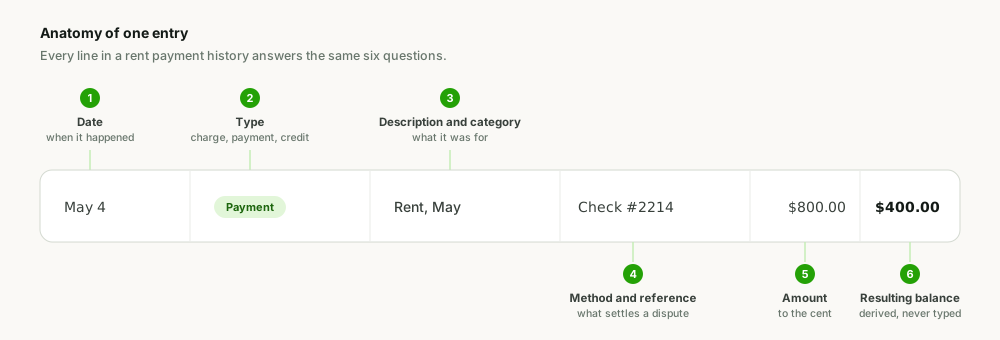
Six fields. Miss one and you’ll feel it later.
- Date. When the charge came due or the payment arrived, not when you got around to writing it down.
- Type. Charge, payment, or credit. Everything else in the record depends on these three staying distinct.
- Description and category. “Rent, June” or “Late fee” or “Water reimbursement, April.” Categories are what let you answer “how much did I collect in late fees last year?” without reading every line.
- Amount. To the cent.
- Method and reference. On payments: “check #2214,” “bank transfer,” “money order #4471,” “cash.” When a payment gets disputed, the reference is what settles it.
- Resulting balance. What the tenant owed the moment that entry posted.
Two more details belong on every entry: which lease and unit it applies to, and which tenant paid, when a lease has more than one name on it.
Keep the history per tenant, not per property. A property-level record tells you $3,400.00 came in this month. It can’t tell you that Unit 3 is $250.00 behind while Units 1 and 2 are current.
A rent payment history example: two months on one lease
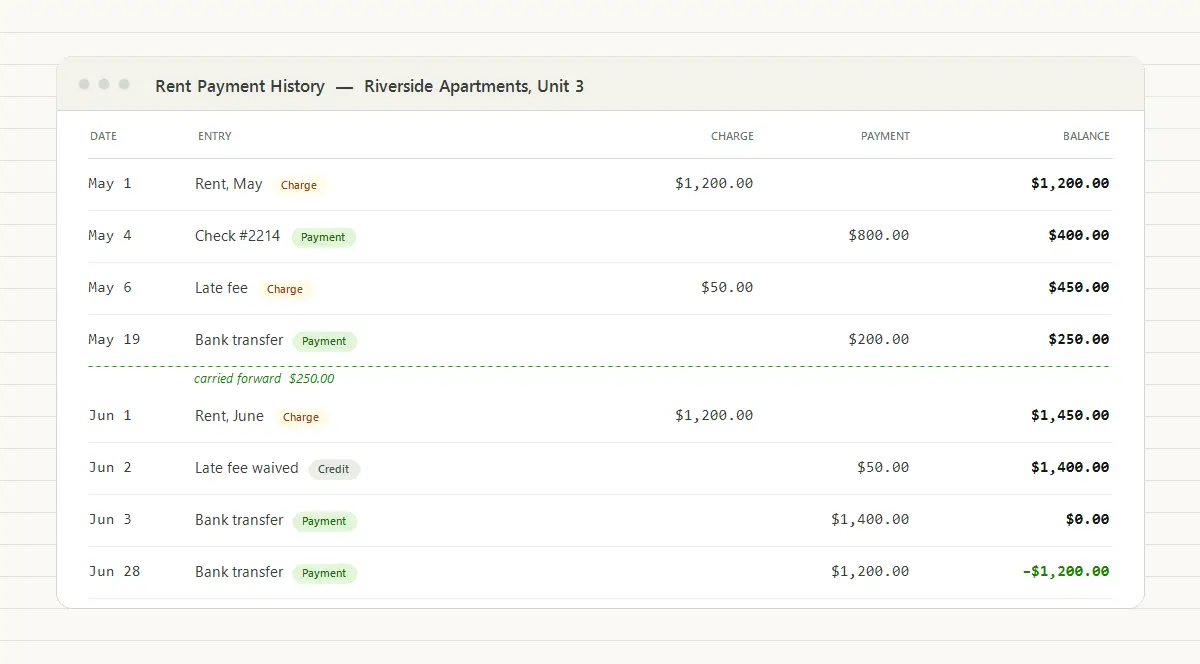
Here are two months for Unit 3 at Riverside Apartments. Rent is $1,200.00, due on the 1st, with a five-day grace period before a $50.00 late fee posts.
| Date | Type | Description | Charge | Payment | Balance |
|---|---|---|---|---|---|
| May 1 | Charge | Rent, May | $1,200.00 | $1,200.00 | |
| May 4 | Payment | Check #2214 | $800.00 | $400.00 | |
| May 6 | Charge | Late fee | $50.00 | $450.00 | |
| May 19 | Payment | Bank transfer | $200.00 | $250.00 | |
| Jun 1 | Charge | Rent, June | $1,200.00 | $1,450.00 | |
| Jun 2 | Credit | Late fee waived | $50.00 | $1,400.00 | |
| Jun 3 | Payment | Bank transfer | $1,400.00 | $0.00 | |
| Jun 28 | Payment | Bank transfer, July rent | $1,200.00 | −$1,200.00 |
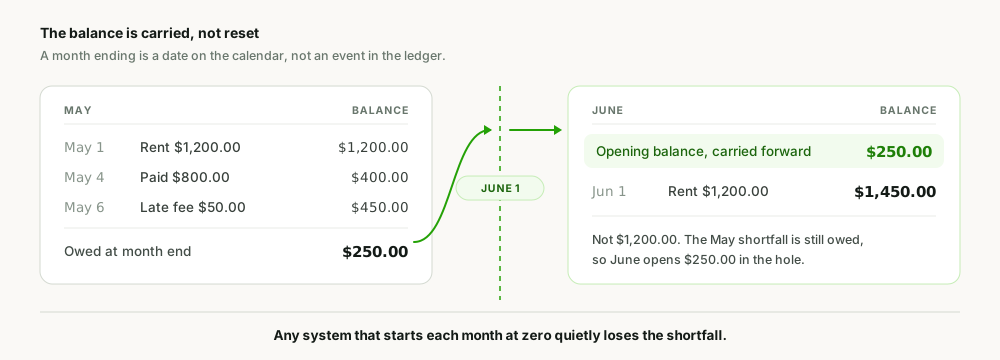
Read it top to bottom and the whole story is there. May rent came in short. The $400.00 remainder was still outstanding when grace ran out, so a fee posted on the 6th. The tenant was still $250.00 behind at the end of the month, and that balance carried into June rather than disappearing when the calendar flipped. In June the fee was waived as a credit, the tenant cleared everything on the 3rd, then paid July early on the 28th.
That final negative balance isn’t an error. It means the tenant is ahead by $1,200.00, and that amount will be absorbed by the July rent charge on the 1st.
Partial payments, late fees, and credits
These three are where most rent records fall apart, and all three fail the same way: somebody edits an existing entry instead of adding a new one.
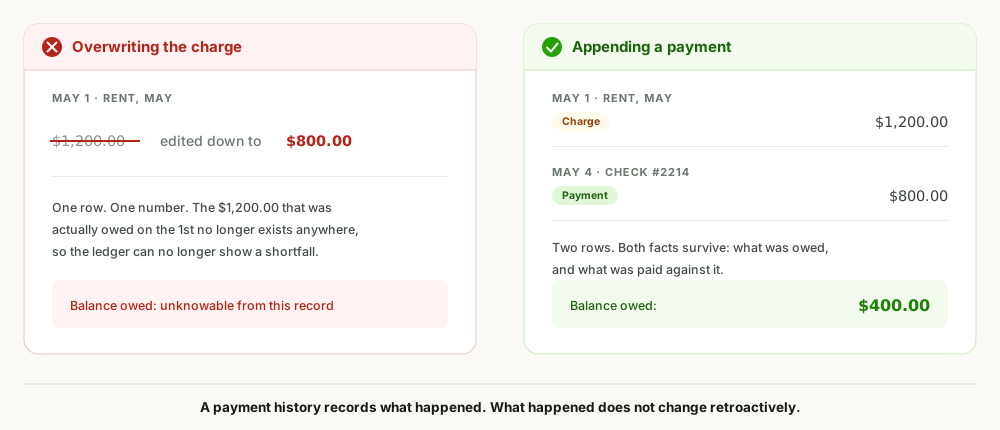
Partial payments. When a tenant pays $800.00 against $1,200.00 of rent, don’t change the charge to $800.00. The charge records what was owed on the 1st, and that fact doesn’t change based on what arrived on the 4th. Record the $800.00 as its own dated payment. The $400.00 still owed is then the difference between two entries rather than a number you maintain by hand.
Late fees. A late fee is a new charge with its own date and category, not an adjustment to the rent charge. Keeping it separate is what lets “was rent paid?” and “was the fee paid?” stay two different questions, which is exactly how a tenant will ask them if they dispute the fee.
Credits. When you waive that fee, resist the urge to delete it. Delete the charge and your record now says the fee never existed, which contradicts the notice you already sent. Issue a credit instead. The history then shows that the fee posted, that it was waived, and when. That version survives a dispute. The deleted version doesn’t.
The rule underneath all three: append, never overwrite. A payment history records what happened, and what happened doesn’t change retroactively.
Why the running balance is the point
A balance you type is a number you have to defend. A balance derived from the entries above it defends itself.
That matters in three specific moments:
- A tenant asks what they owe. You want one tenant balance you trust, today, without adding anything up first.
- A balance crosses a month boundary. The May shortfall in the table above didn’t vanish on June 1. Any system that resets monthly will quietly lose it.
- Somebody disputes a figure. “You owe $250” invites an argument. A dated list of four entries ending at $250.00 usually ends one.
It’s also the difference between knowing you’re owed money and knowing who owes it. Property-level tracking tells you the first. Only a per-tenant history tells you the second.
Common mistakes when tracking rent payments
- A “$1,250 rent” charge. If that’s really $1,200.00 of rent plus a $50.00 fee, netting them corrupts your income categories and your tax reporting at the same time.
- Logging the deposit date instead of the receipt date. A check received on the 3rd and deposited on the 9th is an on-time payment recorded as a late one. Your ledger should track when the tenant paid you.
- Deleting a bounced payment. An NSF or returned payment needs a reversing entry, not an erased one. Otherwise the record can’t explain why the balance moved twice.
- Not recording who paid. On a lease with two names, “payment, $600.00” leaves you guessing six months later about which co-tenant is behind.
- Recording rent only. Utility reimbursements, pet fees, and repair chargebacks are part of what the tenant owes. If those sit on a separate list, your balance is wrong.
- One laptop, one copy. A single spreadsheet with no backup is one hardware failure away from no rent records at all.
Spreadsheet or purpose-built software?
A spreadsheet structured as a transaction log, one row per entry instead of a grid of months, will hold a payment history correctly. What it won’t do is hand you a statement when a lender asks for one, and that request is the reason the record exists in the first place. If you’re weighing the options in detail, the comparison of spreadsheets, accounting software, and purpose-built tools is a post of its own.
How TenantLedger keeps the record for you
Every lease in TenantLedger has a Financials tab, and it’s the payment history described above, kept current as you work. Each row carries the date, the tenant, the entry type, a check number, the charge or payment amount in its own column, and the running balance after that row. Past-due charges are flagged, prepayments are marked as prepaid, and a reversed payment stays visible as reversed instead of vanishing from the record.
The three entries that cause trouble elsewhere are handled as first-class events:
- Recording a partial payment leaves the original charge intact and tracks what’s still owed against it. One charge can take as many payments as it needs.
- A late fee posts on the grace date, derived from the grace period you set in days on the lease, as its own dated charge with its own category.
- You can issue a credit and apply it to a specific charge, and anything unused stays on the Open Credits report until it gets used.
Because every entry is categorized against a chart of accounts, the same records feed the reports that matter at month end: A/R Aging with current, 30, 60, 90, and 120-plus day buckets, the Rent Roll, and Lease Financial Activity. That’s landlord accounting running off the same ledger, not a second set of books to reconcile against the first.
Tenants can see their side of it too. With the tenant portal enabled, a tenant sees their own dated charges and payments and what they currently owe, and anything they pay online lands on the ledger without you entering it.
Producing a rent payment history when someone asks
This is what the whole exercise pays for.
Run the Tenant Statement report and you get the record in the form people actually ask for: a brought-forward opening balance, every charge and payment in the period, a running balance down the page, and the total due at the bottom. It prints, and it saves as a PDF. Running a tenant statement takes about as long as finding the spreadsheet would have.
Three requests it answers:
- A tenant disputes a balance. Hand them the statement. Most disputes end there, because the disagreement is usually about a fee they forgot rather than about arithmetic.
- A lender or another landlord asks for proof of rent. Mortgage underwriters and prospective landlords ask for this constantly, sometimes as a verification of rent form to complete and return, sometimes as an open-ended request for a rent verification letter. A dated statement is a considerably better answer than a letter asserting the tenant paid on time, because it shows the actual dates rather than your recollection of them.
- Your accountant or an attorney needs the record. Reports export to Excel or PDF, which covers what either will normally ask for.
The report only reflects what you recorded, which is the real argument for entering things as they happen rather than reconstructing a quarter in one sitting.
The bottom line
An accurate rent payment history isn’t complicated. It’s a dated list of charges, payments, and credits for one tenant, with a balance that comes out of the list instead of going into it. Get that structure right and the hard questions answer themselves: what does this tenant owe, was that fee ever paid, and can you prove it.
Moving the record into software doesn’t make you a better bookkeeper. It means the entries you were already making are the history, instead of something you assemble later from memory.
If you’d like to see your own leases kept this way, TenantLedger’s 14-day free trial takes an evening to set up: start here, no credit card required. It’s built for landlords and small property managers, and pricing starts at $20 a month.
Common questions
What is a rent payment history?
A rent payment history is the dated record of every charge, payment, and credit for a single tenant, with the balance that resulted from each entry. It answers not just whether rent was paid, but what the tenant owed before and after each transaction. The terms tenant payment history, rental payment history, and tenant ledger all describe the same record.
What should a rent payment history include?
Every entry needs a date, a type (charge, payment, or credit), a description and category, and an amount. Payments also need a method and a reference such as a check number. Each line should show the balance that resulted from it, and charges beyond rent, such as late fees and utility reimbursements, belong in the same record rather than on a separate list.
How long should landlords keep rent payment records?
The usual advice is at least seven years. That rule of thumb comes from tax record-keeping: the IRS generally has three years to assess additional tax and six years if income was substantially understated, so seven years covers both with room to spare. States also set their own rules for security deposit records specifically, so check the requirements where your properties are. Since a digital ledger costs nothing to retain, the practical answer is to keep everything.
How do I give a tenant a copy of their payment history?
Produce a statement for the date range they asked about, showing an opening balance, every charge and payment, a running balance, and the total due. Any system worth using should generate this rather than make you assemble it. In TenantLedger it is the Tenant Statement report, and tenants with portal access can also see their own charges, payments, and current amount owed at any time.
How do I provide proof of rent payment for a lender or another landlord?
A signed statement on your letterhead showing the tenant's charges, payments, and balance over the period requested is what most lenders and landlords mean by proof of rent or a verification of rent form. A dated ledger printout is stronger than a letter asserting the tenant paid on time, because it shows the actual dates. Some lenders send their own VOR form to be completed and returned.
Does rent payment history affect a tenant's credit score?
Not automatically. Rent is not reported to the credit bureaus the way a mortgage or a car loan is, so on-time rent usually has no effect on a credit score unless the tenant or the landlord enrolls in a separate rent-reporting service. Unpaid rent can still reach a credit report indirectly, if a balance goes to collections or a judgment is entered.
Property management software with real accounting built in
Track your properties, leases, charges, and payments in one place.
14-day free trial · No credit card required