
Prorated Rent Calculator: Formula, Examples, and How It Works
August 24, 2026
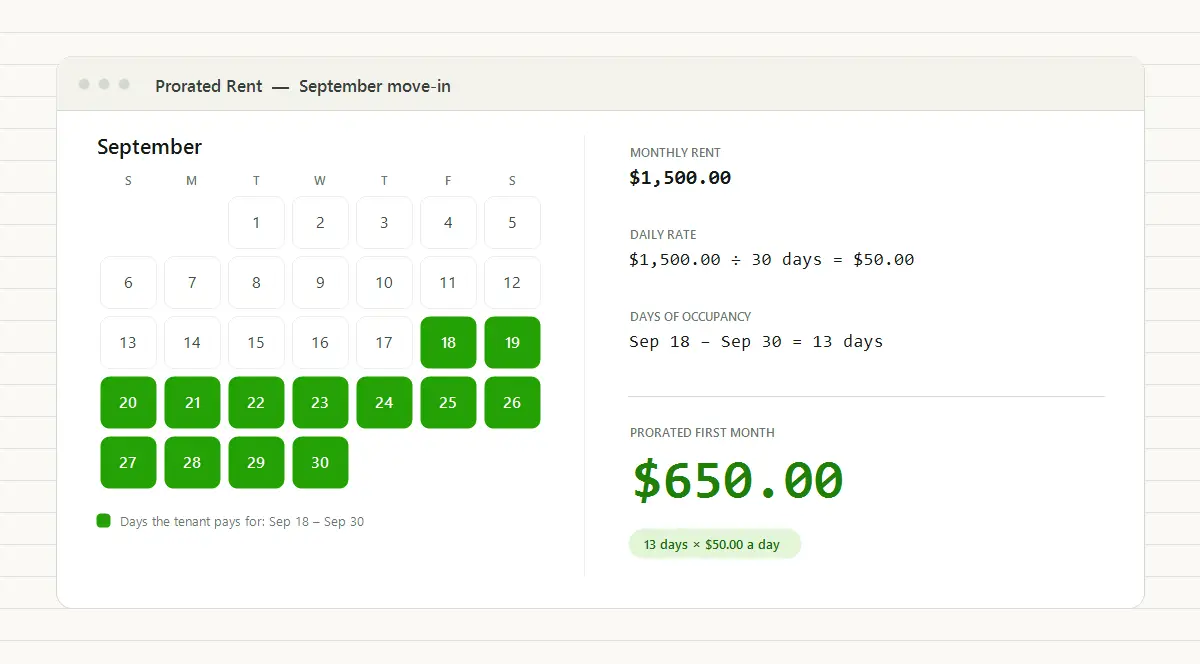
A tenant wants the keys on September 18. Nobody thinks they should pay for the seventeen days the unit sat empty, and no landlord wants to give away two free weeks either. Prorated rent is the fix: the tenant pays only for the days they actually have the place, at a daily rate worked out from the monthly rent.
The math is short division, but the details are where the arguments start. Do you divide by 30 or by 31? Does the move-in day count? Is the last month prorated when a tenant leaves? This guide covers what prorated rent means, the formula, the three methods landlords actually use, and worked examples for move-ins and move-outs. And since most people arrive here needing a number, the calculator comes first.
Prorated rent calculator
Enter the monthly rent, choose whether the tenant is moving in or moving out, and pick the date. The calculator shows the daily rate, the day count, and the prorated rent under each of the three common methods, so it doubles as a rent proration calculator for whichever convention your lease uses.
Daily rates are shown rounded to the cent; totals use the exact rate and round once at the end. If your lease names a proration method, that method wins.
If the number needs to hold up later, write down which method you used and the date range it covers. Both belong on the tenant’s ledger anyway, which is covered at the end of this guide.
What is prorated rent?
Prorated rent is a partial month’s rent, scaled to the number of days a tenant actually has the right to occupy the unit. The term comes from the Latin pro rata, “in proportion,” which is the whole idea: a tenant who has the unit for 13 of September’s 30 days pays 13/30ths of the month’s rent.
Two details in that definition do real work. First, prorating runs on the right to occupy, not on furniture. A tenant whose lease starts on the 18th owes rent from the 18th even if the moving truck shows up on the 25th. Second, the move-in day itself counts. The tenant has keys that day, so the daily rate applies to it.
What prorated rent is not: a discount, a negotiation tactic, or something that applies to the security deposit. The deposit is a fixed amount and is collected in full no matter what day the lease starts.
When do landlords prorate rent?
Four situations account for nearly all of it:
- A mid-month move-in. The classic case. The lease starts on any day other than the 1st, and the first (or second) month is prorated to match. How to handle that first partial month is its own decision.
- A mid-month move-out. Prorating applies only when the tenancy itself ends mid-month, which usually means a month-to-month tenant whose notice period lands there, or an early-termination date both sides agreed to. A tenant who leaves on the 20th of a lease that runs through the 31st owes the full month.
- A mid-month rent change. When a renewal or increase takes effect mid-period, each rate applies to its own days: the old daily rate up to the change date, the new one after.
- Holdover days. A tenant who stays past the end date owes for the extra days, typically at a daily rate, and often a steeper one if the lease says so.
The common thread is a billing period that does not line up with a calendar month. Prorating is how the rent gets mapped onto the days that actually belong to the tenant.
How to calculate prorated rent: the formula
The prorated rent formula has two steps: turn the monthly rent into a daily rate, then multiply by the days that belong to the tenant.
Daily rate = monthly rent ÷ days in the billing basis
Prorated rent = daily rate × days the tenant has the unit
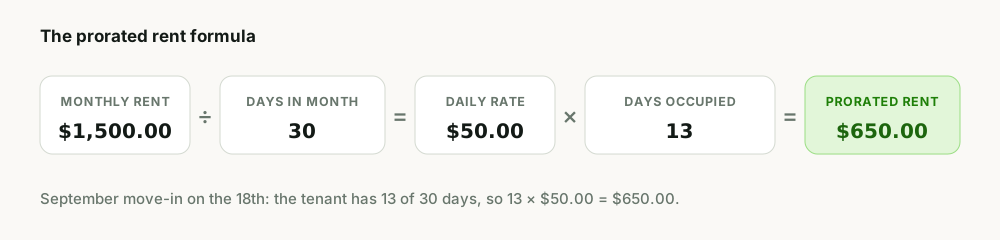
Counting the days is where mistakes creep in, so two rules:
- Move-ins count the move-in day through the last day of the month, inclusive. Move in on September 18 and the tenant has the unit for September 18 through 30, which is 13 days (30 − 18 + 1, because the 18th itself counts).
- Move-outs count the 1st through the final day of the tenancy, inclusive. A tenancy that ends October 10 covers October 1 through 10, which is 10 days.
That leaves one open question: what number goes in the denominator? That choice is the entire difference between the methods.
30 days or actual days? Three ways to prorate rent
Ask how to prorate rent and you are really asking how to set the daily rate. Three conventions cover what landlords actually do, and for a $1,500.00 unit they produce three different rates:
| Method | How the daily rate is set | Daily rate in August (31 days) | Daily rate in February (28 days) |
|---|---|---|---|
| Actual days in the month | $1,500.00 ÷ days in that month | $48.39 | $53.57 |
| 30-day month (“banker’s month”) | $1,500.00 ÷ 30, every month | $50.00 | $50.00 |
| 365-day year | $1,500.00 × 12 ÷ 365 | $49.32 | $49.32 |
Actual days in the month divides the rent by that month’s real length, 28 to 31 days. The daily rate moves around a little, but every full month sums back to exactly one month’s rent, which makes it the easiest method to defend in a dispute. If the lease is silent, this is the convention to reach for.
The 30-day month, or banker’s month, pretends every month has 30 days. The appeal is a daily rate that never changes. The catch is the edges: charge that rate for all 31 days of August and the “partial” month comes to $1,550.00, more than the rent itself, and a full February comes to $1,400.00, less. It behaves fine for genuinely partial months; just never apply it to a full one.
The 365-day year annualizes the rent and divides by 365 (some leases use 366 in leap years). Property managers who prorate a lot like it because one daily rate holds all year. The per-day number lands between the other two methods in long months.
None of the three is more correct than the others. Pick one, write it into the lease, and apply it the same way every time. The proration on a move-out should be computed the same way it was on the move-in, even when a different method would favor you that month.
Example: prorated rent for a mid-month move-in
A tenant leases a unit at Riverside Apartments for $1,500.00 a month and moves in on September 18. September has 30 days.
| Step | Calculation |
|---|---|
| Days in September | 30 |
| Daily rate | $1,500.00 ÷ 30 = $50.00 |
| Days the tenant has the unit | Sep 18 through Sep 30 = 13 days |
| Prorated rent | 13 × $50.00 = $650.00 |
September is a convenient month: it has exactly 30 days, so the actual-days method and the 30-day method agree to the penny.
Slide the same move-in to August 18 and the methods split. August has 31 days, so the tenant has the unit for 14 of them. Actual days: $1,500.00 ÷ 31 = $48.387 a day, × 14 days = $677.42. The 30-day method: $50.00 × 14 days = $700.00. Same tenant, same unit, same rent, and a $22.58 gap. Neither number is wrong. What would be wrong is not being able to say which convention produced the one you charged, which is why the method belongs in the lease and on the ledger entry.
Example: prorated rent when a tenant moves out
Move-outs prorate less often than move-ins, because the proration only applies when the tenancy legally ends mid-month.
Say a month-to-month tenant at $1,500.00 gives proper notice and the tenancy ends October 10. October has 31 days, and the tenant owes for October 1 through 10, the 10th included, since the tenancy runs through that day.
| Step | Calculation |
|---|---|
| Days in October | 31 |
| Daily rate | $1,500.00 ÷ 31 = $48.387 |
| Days the tenant has the unit | Oct 1 through Oct 10 = 10 days |
| Prorated final month | 10 × $48.387 = $483.87 |
Two cautions. First, this only works because the tenancy actually ends on the 10th. When a fixed-term lease runs through October 31, a tenant who hands back keys on the 10th still owes the full $1,500.00. Second, returning keys early does not end a tenancy by itself; the notice, the lease, and state law decide when the obligation stops. If you are unsure whether the tenancy ends mid-month, that question comes before any math.
Prorate the first month or the second?
For move-ins there is a practical question the formula cannot answer: collect the prorated amount first, or a full month first?
Many experienced landlords collect a full month’s rent plus the deposit before handing over keys, then prorate the second month. The reasoning is about risk, not arithmetic. The largest payment clears before the tenant has possession, and if a payment is ever going to fail, better the small one later than the big one on day one.
The totals are identical either way, and conveniently, so is the number. For the September 18 move-in above:
- Prorate the first month: the tenant pays $650.00 before moving in, then $1,500.00 on October 1.
- Prorate the second month: the tenant pays $1,500.00 before moving in. That covers the 13 September days ($650.00) plus $850.00 toward October, which leaves $650.00 due on October 1.
Either way the tenant pays $2,150.00 through October; the only difference is which payment is the big one. Whichever you pick, the lease should say so, and the deposit is collected in full at the start regardless.
Prorated rent and the lease agreement
A prorated rent clause in the lease agreement removes every argument this article has mentioned so far. It needs to cover four things:
- The method. Actual days, 30-day month, or 365-day year.
- Which month is prorated. The partial first month, or a full month up front with the proration applied to month two.
- When it is due. Typically before the tenant takes possession for a move-in, and on the regular due date for a prorated final month.
- Holdover terms. The daily rate (and any premium) if the tenant stays past the end of the term.
A serviceable clause runs about one sentence:
If the term begins on a day other than the first day of a calendar month, Tenant shall pay prorated rent for that partial month, calculated at a daily rate equal to the monthly rent divided by the number of days in that month, multiplied by the number of days from the commencement date through the end of that month. Prorated rent is due on or before the commencement date.
Have your attorney adapt any clause to your state before it goes in a lease. The point is that the method and the due date exist in writing before the first day of the tenancy, because that is cheap, and reconstructing the agreement later is not.
Is prorating rent required by law?
For move-ins, generally no. Prorating the first partial month is near-universal practice, and a tenant asked to pay a full month for ten days of possession will push back for good reason, but in most of the country it is a matter of agreement rather than statute. The lease controls.
Move-outs are where prorated rent laws actually bite, indirectly, through notice rules. State statutes set how a month-to-month tenancy ends: in some states notice can end the tenancy on any day, which produces a prorated final month, while in others the tenancy runs to the end of a rental period, which produces a full one. The proration itself is rarely legislated; the end date is, and the end date determines whether there is anything to prorate.
The practical rules that fall out of this:
- Check your state and city rules on notice periods and termination dates before promising, or refusing, a prorated last month.
- Do not confuse leaving early with ending the tenancy. A broken fixed-term lease usually leaves the tenant owing rent going forward, subject to your duty to re-rent in most states. That is a different problem from proration.
- Write the method into the lease so the enforceable answer and the mathematical answer are the same thing.
None of this is legal advice, and the details genuinely vary by jurisdiction. When a move-out gets contentious, the statute and a local attorney outrank any calculator, this one included.
Recording a prorated month on the ledger
However you collect it, the prorated amount should land on the tenant’s ledger as its own dated charge, not as a scribbled adjustment to the regular rent. The record you want to see a year later reads like this:
| Date | Type | Description | Charge | Payment | Balance |
|---|---|---|---|---|---|
| Sep 18 | Charge | Prorated rent, Sep 18–30 | $650.00 | $650.00 | |
| Sep 18 | Payment | Bank transfer | $650.00 | $0.00 | |
| Oct 1 | Charge | Rent, October | $1,500.00 | $1,500.00 |
The description carries the date range, the amount carries the math, and the running balance shows it was paid. When a tenant asks in February why September was “short,” the ledger answers without you.
In TenantLedger this takes about a minute. You move the tenant in, set the regular rent as a recurring charge starting on the first full month, and add the prorated amount as a one-time charge dated the move-in day, categorized as rent income so your reports stay honest. With the tenant portal turned on, the tenant sees the charge and pays it online, and the payment posts to the rent ledger without anyone retyping it.
The bottom line
Prorated rent is proportion, nothing more: a daily rate times the days the tenant actually has the unit. The daily rate comes from dividing by the actual days in the month, by 30, or by 365ths of a year, and any of the three works as long as the lease names it and you apply it consistently. Move-ins prorate as a matter of course; move-outs prorate only when the tenancy truly ends mid-month; the deposit never prorates at all. Late fees, rent increases, and deposit interest get the same treatment, formula first, in the free landlord calculators.
Run the number in the calculator above, put the method in the lease, and give the amount its own line on the ledger. If you would rather the ledger part kept itself, TenantLedger’s 14-day free trial takes an evening to set up: start here, no credit card required.
Common questions
What does prorated rent mean?
Prorated rent is a partial month's rent, adjusted in proportion to the number of days a tenant actually has the unit. Instead of a full month, the tenant pays a daily rate multiplied by their days of occupancy. The term comes from the Latin pro rata, meaning in proportion, and it comes up most often for mid-month move-ins and move-outs.
How do you calculate prorated rent?
Divide the monthly rent by the number of days in the month to get a daily rate, then multiply by the number of days the tenant occupies the unit. For a $1,500.00 unit and a September 18 move-in: $1,500.00 divided by 30 days is $50.00 a day, times 13 days is $650.00. Some landlords divide by 30 every month or use a 365-day annual rate instead; any method works as long as the lease says which one applies.
Is prorated rent based on 30 days or the actual days in the month?
Either, and the lease should say which. The actual-days method divides the monthly rent by that month's real length, 28 to 31 days, so the daily rate shifts from month to month. The 30-day method, sometimes called a banker's month, divides by 30 every time, which is simpler but runs slightly high in 31-day months and slightly low in February. Most landlords use actual days because it matches the calendar and is the easiest to defend.
Is rent prorated when a tenant moves out?
Only when the tenancy itself ends mid-month. If a month-to-month tenant gives proper notice and the tenancy ends on the 10th, they owe rent through the 10th, prorated. If the lease runs through the end of the month, moving out early does not shrink that month's bill: the tenant owes the full month because they had the right to occupy it. Notice rules vary by state, so check when a tenancy can legally end where the property sits.
When is prorated rent due?
For a move-in, prorated rent is typically due before the tenant gets keys, either when the lease is signed along with the deposit or on the move-in date itself. For a move-out, the prorated final month is due on the normal rent due date. Whatever you choose, write the due date into the lease so there is nothing to argue about later.
Should the first month or the second month be prorated?
Many landlords collect a full month's rent plus the deposit before handing over keys, then apply the proration to the second month. The tenant pays the same total either way; collecting the full month first just means the larger payment clears before the tenant has possession. Prorating the first month directly is also fine, especially when the move-in lands early in the month.
Do you prorate the security deposit too?
No. The security deposit is not rent, so it is never prorated. It is a fixed amount set by the lease, capped by state law in many places, collected in full at move-in regardless of the date, and refundable at move-out subject to lawful deductions.
Is a landlord required to prorate rent?
Usually not for move-ins: prorating a partial first month is standard practice and tenants expect it, but in most places it is a matter of agreement rather than law. Move-outs are different, because notice statutes control when a month-to-month tenancy ends, and if it legally ends mid-month the tenant owes only the prorated amount. A few states and cities have their own quirks, so check local rules and put your method in the lease.
Property management software with real accounting built in
Track your properties, leases, charges, and payments in one place.
14-day free trial · No credit card required